
Why Rote Learning Fails Your Child and What Actually Works
As educators, we watch children face the growing pressure of school every day. When a child struggles with long division or struggles to write a cohesive essay, the frustration does not stay at school. It comes home, filling the dinner table with tension and homework sessions with tears. If you are searching for a Math help center in Tracy families trust, you likely want more than just higher test scores. You want to see your child smile again when they face a difficult challenge. Our goal is to transform that academic anxiety into real, lasting confidence by addressing the root causes of learning difficulties.
Finding the right support can feel overwhelming. Many parents look for qualified math tutors in Tracy who can provide support, hoping to find someone who understands how children actually process numbers. We believe that true learning goes beyond memorizing formulas for a Friday test. It is about changing how a child views their own potential, turning fear of failure into the excitement of discovery. By focusing on a student-centered approach, we help children build the foundational skills they need to navigate an increasingly complex academic world.
Why does traditional tutoring often miss the mark?
A lot of academic support programs are built around short-term fixes. They can help a student make it through tonight’s homework or pass tomorrow’s quiz, but somehow they do not really address the root comprehension gaps. So the whole thing turns into a quick-fix loop, and the student ends up dependent on the tutor, feeling kind of stuck when new, unfamiliar problems show up without help. This shows up a lot in STEM subjects, too.
Recently, international data points to a big pattern in math education. In the 2022 Programme for International Student Assessment (PISA), Singapore scored a top ranking of 575 points in mathematics, while the international average was far lower. The reason for this isn’t “more hours” of repetitive drills. Instead, it is a deep conceptual mindset, one that teaches students how to reason, not just what to repeat. When we lean only on rote memorization, we lose the chance to show kids how numbers actually behave in the real world.
What is the secret behind Singapore-style learning?
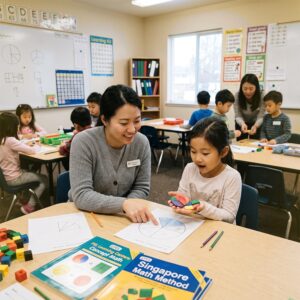
We use a structured teaching method that lines up with this global benchmark. Rather than starting straight with abstract equations, we lead students through three essential phases: concrete, pictorial, and abstract. We think a child should first touch and observe a concept before they try to solve it on paper.
For example, with fractions, a student may begin with physical blocks to grasp parts of a whole. Then they shift to drawing diagrams of those blocks. After that, they write the numbers and equations. This sequence builds a natural sense, so later on, advanced algebra and calculus feel much easier to understand in everyday life, not just in class. Our instructors act as guides who model these concepts and then step back, allowing the student to lead their own discovery.
How does character change drive academic success?
We know that academic progress is deeply linked to a child’s mindset. If a student thinks they are “bad” at math, no tutoring, even the best one, really sticks. So we focus on changing character while academic skills also grow. In other words, we work hard to build those quiet success skills, like organization, goal-setting, and steady focus.
When a student figures out how to manage their time and sort their study materials, they start taking real ownership of their education. This shift in responsibility builds a lot of self-confidence. A child who used to avoid homework now tackles it alone because they have the tools, plus the belief they can solve the problems on their own.
What does a day of active learning look like?
Our daily routine is designed to foster independence and master new skills. We do not use passive lectures. Instead, we use a structured flow that keeps students engaged and accountable.
Here is how we structure our learning environment compared to traditional classrooms:
| Learning Phase | Traditional Rote Classrooms | Our Active Approach |
| Concept Introduction | Teacher lectures the whole group | Instructor models the concept individually |
| Coaching | Students work alone with little feedback | Instructor provides targeted guidance as needed |
| Error Correction | Errors are graded later at home | Errors are corrected immediately in class |
| Task Mastery | Moving to the next topic regardless of grade | Moving forward only after complete mastery of the concept |
We focus on specific core milestones that help students progress systematically. These areas include:
- Building a deep conceptual understanding of numbers and language arts.
- Practicing error correction immediately to prevent bad habits from forming.
- Encouraging students to explain their work in their own words to prove understanding.
- Fostering independent study routines that build lasting self-reliance in daily life.
By focusing on these milestones, we ensure that every student has a solid foundation before they move on to more advanced topics. This structured progression is what allows our students to catch up and eventually study ahead of their current grade level.
What is the path forward for your child?
Helping your child succeed is mostly about picking a program that changes how they think. If you are ready to explore a trusted Math help center in Tracy that parents rely on, or if you need the steady guidance of professional maths tutors in Tracy families recommend, we invite you to take that first step. Using a proven methodology, PEL Learning Centers offers personalized instruction and character-building skills your child needs to master their studies and gain lifelong confidence.
Frequently Asked Questions
Q. What age groups do you support in your programs?
We provide comprehensive academic support for K-12 students, helping young children build early numeracy skills and guiding high schoolers through advanced subjects.
Q. How much time do students need to dedicate to this program?
Students typically visit our center twice a week for about 30 to 45 minutes per subject, and complete short daily assignments at home that take about 15 to 25 minutes.
Q. Do you offer support for reading and writing as well?
Yes, we offer a complete English Language Arts program that covers reading comprehension, writing, and vocabulary, using materials from history, science, and classic literature.
Q. How do you measure a student’s progress?
We start with a free assessment to identify exact learning gaps, and then monitor performance daily through master worksheets and regular check-ins.
Q. Can this program help students who are already ahead in school?
Absolutely, because our instruction is fully individualized, advanced students can progress at their own pace and study material well beyond their current grade level.
Call Us Today 1 (833) 299-4744 or email us at info@PELLearning.com to book your appointment today